

Leadership For Fire Professionals


- Description
This premier fire service leadership academy provides fire captains, battalion chiefs, and public safety directors with the executive framework required to eliminate workplace friction, optimize budgets, and build high-performing crews of self-actualized adults.

Format: 40‑Hour Live Online Academy (Five-Session Series)
Dates: Monday, November 30 - Friday, December 4, 2026
Daily Schedule: 09:00 MST begins promptly | 30-Minute Group Break Daily
Certification: 40‑Hour Certificate of Completion awarded upon full attendance
Give your fire professionals the skills, confidence, and strategic mindset your agency needs—and your community expects. Enroll them in The Leadership Academy for Fire Professionals and strengthen the leaders who will guide your organization into the future.
This five‑session series equips emerging and current fire service supervisors with the strategic, operational, and people‑centered leadership capabilities required in today’s fire and emergency services environment. Participants learn how to think and plan like executives, lead crews with clarity and adult accountability, manage budgets with confidence, and strengthen both internal culture and community trust. Each session builds practical capability—strategic planning, leadership and management principles, fiscal stewardship, team development, and community/media relations—giving fire professionals the tools to support long‑term organizational success.
Who Should Attend
This comprehensive fire-service leadership program is designed to align professional standards across all ranks, shifts, and divisions, making it highly valuable for:
Fire Service Command Staff & Company Officers
- Battalion Chiefs & Division Chiefs: Mid-level command officers looking to transition from daily tactical fireground response to strategic organizational leadership.
- Station Captains & Lieutenants: First-line company officers responsible for crew development, shift-change continuity, and maintaining a healthy station culture.
Emerging Leaders & Specialist Divisions
- Promotional Candidates & High-Potential Staff: Personnel preparing for upcoming promotional assessments who need an executive-level view of governance and strategy.
- Specialized Unit Managers: Leaders across Operations, Prevention, Training, Communications, Administration, or Support Services looking for shared leadership language.
Public Safety Executives & Civilians
- Agency Directors & Civilian Personnel: Non-sworn administrators and user board members tasked with fiscal oversight, public information, or organizational development within fire and EMS frameworks.
Academy Curriculum & Session Outlines
Session 1 – The Fire Professional’s Role as Visionary & Strategic Planner
Move past reactive firefighting mode and learn the strategic mechanics required to guide your agency over a twenty-year horizon.
- Strategic issues facing the fire service over the next decade.
- Executive‑level techniques for strategic and tactical planning.
- Improving productivity, operational quality, and organizational learning.
- Developing an effective, actionable Mission and Vision that drives daily operations.
- Principles of strategic planning and building a Planning Cycle Calendar tied directly to your agency’s budget.
Session 2 – Implementing Effective Leadership & Management Principles
Trade administrative friction for clear communication frameworks that empower your crew to step into adult accountability.
- Creating a station and department environment that supports sound decision‑making and personal ownership.
- Implementing an effective, growth-focused performance review system.
- Strengthening communication lines across ranks, shifts, and divisions to eliminate organizational noise.
Session 3 – The Fire Professional’s Role in Finance & Budgeting
Master the language of public sector procurement and learn how to position your resource requests successfully before policymakers.
- Preparing for rigorous budget presentations without getting bogged down in bookkeeping.
- Aligning department operational goals with the overarching municipal budget process.
- Presenting and defending your budget requests to policymakers, city committees, and the public.
- Involving external decision‑makers throughout the budgeting process to secure long-term capital support.
Session 4 – The Fire Professional’s Role in People Management
Dismantle the toxic friction that stalls performance and transform your crew into a cohesive, mission-focused collective.
- Defining the true mechanics of a “team” within a fire‑service and high-stress context.
- Building and sustaining resilient, mission‑focused teams that own their outcomes.
- Identifying and systematically overcoming psychological and operational obstacles to team performance.
- Senior leadership’s absolute responsibility to model behavioral expectations and protect cultural health.
Session 5 – The Fire Professional’s Role in Community & Media Relations
Own your agency\'s public narrative and tell your story with clarity and transparency, especially during critical incidents.
- Why every fire and rescue agency needs an effective, proactive public‑facing communication strategy.
- Fundamentals of marketing, community relations, and local media engagement.
- Structuring the role of an effective Public Information Officer (PIO) for maximum transparency.
- Handling negative press, managing high-pressure media cycles, and conducting professional press conferences.
- Sharing your agency’s real-world impact directly with constituents without relying solely on local media outlets.
Course Logistics & Participation Requirements
- Technology Requirements: Each student must use a dedicated computer or laptop equipped with both a functioning camera and microphone. A strict roster is maintained for compliance and certification documentation.
- Registration Policy: Select the number of attendees and complete payment by credit card—no PayPal account required. Your emailed receipt serves as your official proof of registration. If an unavoidable scheduling conflict arises, contact the instructor directly to discuss options.
RECOMMENDED READING: Check out Steve\'s books by clicking the cover photos below.
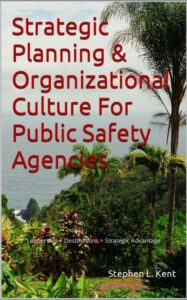
“This book should be in every police and fire leader\'s (formal and informal) library. It should be referenced regularly, not gathering dust. It contains a wealth of applicable wisdom.”
— Christian Tubbs, MS, MA, EFO, CFO, CFC, MIFireE
\"Many of my clients would need a lot fewer policies if all they did was hire adults.\"
— Stephen L. Kent
 The Guidant Path: Organizational Series - The Master Collection
In any sector, whether for-profit, not-for-profit, or public, a group of people without a plan is a group of people in a state of high-functioning anxiety.
That is not, I repeat, not a “team” … it is a group of policy-worshipping, fearful, indecisive bureaucrats who quickly learn how to lie, perhaps. But not a “team.” All the “motivational” speakers, “retreats,” posters, bumper-sticker philosophies, and superficial bling are not going to solve that.
To have a positive, rewarding culture, you must have a true strategic plan and a culture wherein everyone has accepted the personal accountability to focus on the Big Why … not to be confused with a wish list for ways to spend more money or a document that gathers dust while everyone continues in the comfort of non-adult choices.
Comments are closed, but trackbacks and pingbacks are open.