


If your supervisor doesn’t have a plan, there may be a lot of reasons why. Perhaps they don’t know how to plan. Perhaps they are addicted to short-term problem solving and putting out fires, which is a self-inflicted wound for any supervisor. Perhaps they think planning is too complicated or requires more time than they have. Or perhaps they are still doing the job they were promoted from instead of doing the job they were promoted to. None of those are things you can do much about. You probably can’t teach your boss how to plan, break an addiction to firefighting, simplify their thinking, or convince them to stop doing the job they used to have.
But you can decide what you are going to do about the absence of a plan.
You can whine and complain about it, or you can do what I call leading up. Leading up doesn’t mean taking over your boss’s job. It means recognizing that something needs to be done and deciding that you can contribute to solving the problem rather than simply complaining about it.
If your boss doesn’t have a plan, perhaps you can develop one. Read through this article and think about what you might propose. You may discover that you have a pretty good idea of where the organization needs to go – what success looks like in the future – and what it needs to do to get there.
There are two kinds of people: them that plan and them that get to live with the plan.
So let’s talk about what planning actually means.
The word plan comes from a Latin word, planta, which means the sole of the foot. I like that because it captures something fundamental about planning. You set your foot forward and move in a direction. Planning isn’t doing whatever happens to be next. It isn’t reacting to the latest problem, responding to the latest email, scheduling another meeting, or creating a list of activities that keep everyone busy. Planning begins by identifying where you want to end up.
The first question in planning is therefore not, “What are we going to do?” The first question is, “What will success look like?” You need to identify the ideal conditions of success you want to create in the future. Those aren’t tasks, activities, or decisions. They are results. How will you know that the organization has succeeded? What will be different? What will you be able to see, measure, or experience that tells you the desired result has been achieved?
Those success indicators become the destination. If you think of the organization as being on a path, the objective is the summit. You need to know where the summit is before you can determine which direction to travel.
Once you know the destination, you can begin figuring out the path. What needs to happen between where you are now and where you want to be? What is the order of march? What has to be done, who is going to do it, and when does it need to be completed? What resources will be required? What are the revenue and expenses associated with each step?
This is where planning becomes practical.
In order to be considered a true plan it must have six basic components. The first is the objective, which is a statement of the desired outcome. It tells us where we are going. The second is the standards of performance, which identifies how we will know whether we have achieved that objective. These are the success indicators that allow us to distinguish accomplishment from activity. The third component is actions, which are the tasks that have to be completed to produce the desired result. The fourth is accountability, which identifies who is responsible for completing each action. The fifth is the timeline, which establishes when those actions will be completed. The sixth is the budget, which identifies the revenue and expenses associated with achieving the objective.
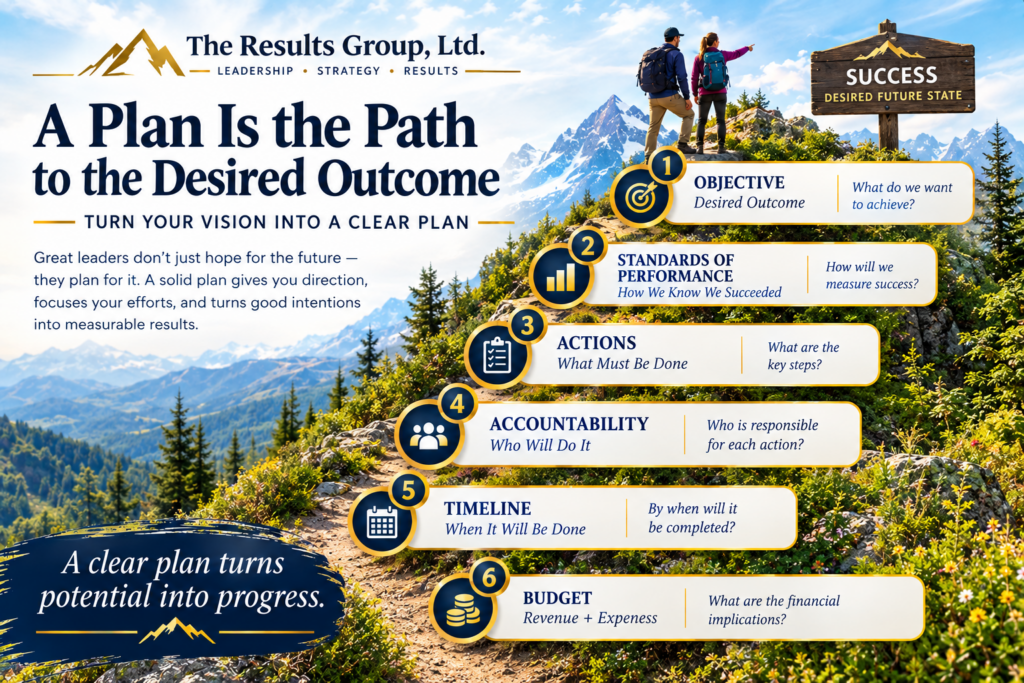
All six matter, but they don’t all have equal importance at the beginning of the process. The objective comes first because everything else should serve the objective. If you don’t know what you’re trying to accomplish, you can’t meaningfully determine what actions need to be taken, who should be responsible for them, when they should be completed, or what they should cost.
That is also why I believe organizations sometimes misunderstand the role of the budget. The budget is important, but the budget isn’t the plan. A budget is the financial representation of a plan – it is simply the fuel needed to get to the destination. It tells you what the plan means financially, but it doesn’t tell you what the organization should accomplish.
Starting with the budget can put the organization in a backwards position. You begin by asking, “What can we afford to do?” Planning begins with a different question: “What do we need to accomplish, and what will it take to accomplish it?” Once you know the desired result and the path required to produce it, you can determine the financial implications.
The plan must also be tied to the organization’s mission. The mission provides the larger purpose for the organization. The plan translates that purpose into a specific set of desired results and a path toward achieving them. I have written separately about how to write a mission statement because a plan that isn’t connected to the organization’s purpose can easily become nothing more than a collection of projects and activities.
So, what should you do if your boss doesn’t have a plan?
You could continue complaining about it. You could wait for your boss to figure it out. Or you could start thinking like a planner. Ask yourself what success should look like. Identify the results that would demonstrate that success. Think about the actions necessary to produce those results. Determine who should be accountable for each action and when it should be completed. Finally, consider the financial implications.
Then put it on paper. The format is simple:
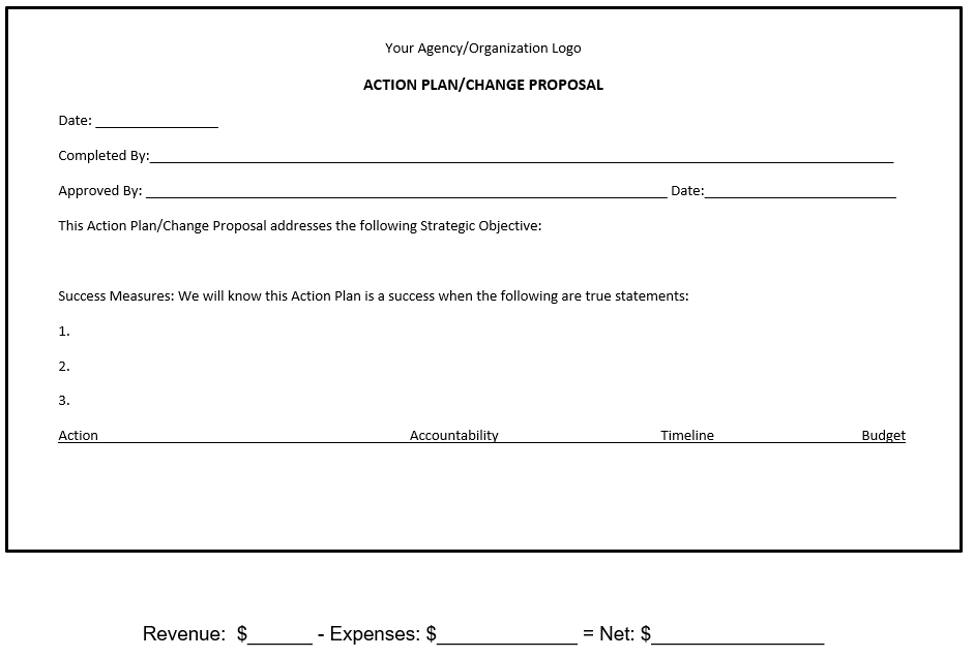
You may find that you have done something remarkably useful. Instead of complaining that your boss doesn’t have a plan, you’ve developed a possible plan yourself.
You don’t have to walk into your boss’s office and say, “You don’t have a plan.” That probably isn’t going to produce the response you’re hoping for. You might instead say, “I’ve been thinking about where we need to go. Here’s what I think success could look like, and here’s a possible path for getting there. What do you think?”
That’s leading up.
And sometimes leadership begins before anyone gives you permission to lead.
If you have a problem you’d like to discuss in a confidential, no-obligation Zoom visit, you can self-schedule it by clicking on this button:

Use this form to be notified about new articles as I publish them!
Author’s Note: The content provided in this article is designed exclusively for educational and informational purposes, reflecting opinions shaped by decades of leadership training and organizational consulting experience. It should never be interpreted as formal professional advice. By reading or engaging with this material, you acknowledge that no professional-client relationship is established and that these insights do not substitute for tailored guidance from a qualified professional familiar with your specific circumstances. Consequently, readers are strongly advised to seek independent counsel from licensed legal, financial, medical, or other appropriate advisors before implementing any strategies or making decisions based on these perspectives. Ultimately, you assume full personal responsibility for any actions you choose to take or omit as a result of reading this material, releasing the author and publisher from any liability for outcomes arising from your reliance on the text.
