

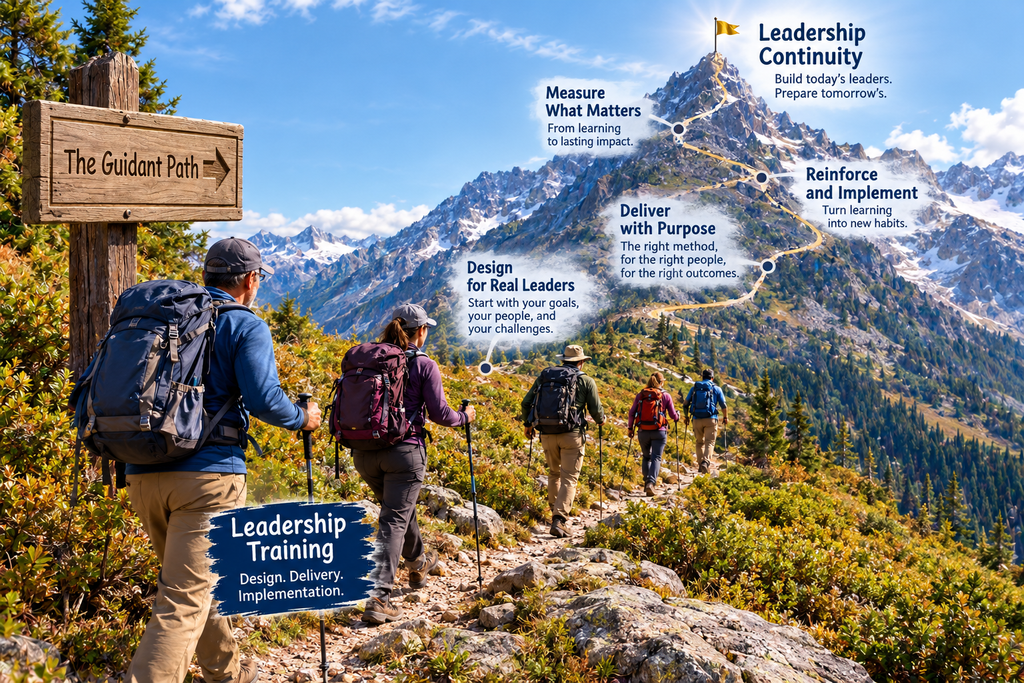
Leadership training is easy to buy and surprisingly difficult to do well. An organization can hire a trainer, schedule a workshop, provide a workbook, put people in a classroom or in front of a computer, and then announce that the leadership training has been completed. But completing training is not the same thing as developing leaders. The real question is whether the training changes what people know, what they do, and ultimately what the organization is able to accomplish. (For more insight, read my article, “The Death of Training: Why Too Many “Instructors” Fail Adult Learners“)
I have spent many years designing, delivering, and implementing leadership development programs for public agencies, businesses, and other organizations. Over that time, I have learned that good leadership training is not one thing. It is a process that begins long before the instructor walks into the room and continues long after the participants leave. I think about that process in terms of three connected ideas: design, delivery, and implementation. They are different parts of the same responsibility, and if any one of them is neglected, the value of the entire effort can be diminished.
The first question should never be, “What leadership training should we buy?” The better question is, “What do we need our leaders to be able to do?” That may sound like a small distinction, but it changes the entire conversation. Training should begin with the organization, its circumstances, its people, and the results it needs to achieve. Perhaps supervisors are struggling to have difficult conversations. Perhaps newly promoted leaders know their technical jobs but have never learned how to lead other people. Perhaps an organization is growing and needs to prepare people for greater responsibility. Perhaps experienced leaders are approaching retirement and the organization needs to develop the people who will eventually carry the work forward.
Those are different problems, and they should not all receive the same training simply because somebody has decided that the organization needs a leadership program. Good training design begins by identifying the gap between where people are and where they need to be. (Read my article: “How Do I Develop a Career Plan?” That means understanding what leaders currently know, what they currently do, what they need to do differently, and what the organization expects to accomplish as a result.
I have always believed that leadership training should deal with the actual work of leadership. That sounds obvious, but it is surprisingly easy to lose sight of it. Leadership development can become a collection of theories, models, acronyms, personality assessments, inspirational stories, and interesting conversations without ever getting around to the question of what a leader actually needs to do on Monday morning.
That is one reason I make a distinction between management and leadership. We manage things. We manage budgets, schedules, equipment, projects, systems, information, processes, and resources. We lead people. Management involves planning, organizing, leading, and controlling the things that have to be managed in order to accomplish something. Leadership involves the human beings who are expected to accomplish it.
Once that distinction is understood, leadership training becomes much more practical. Leaders need to know how to establish expectations, communicate clearly, make decisions, deal with conflict, develop other people, accept responsibility, respond when things go wrong, and create the conditions in which people can succeed. Those are not abstract leadership concepts. They are things that happen every day in every organization.
That is also why I am cautious about off-the-shelf leadership training. There is certainly value in established leadership concepts and proven educational methods, but an organization should not have to reshape its leadership problems to fit somebody else’s training package. The training should be designed around the organization’s needs. A leadership program for a public safety agency may have some things in common with a leadership program for a private company, but the circumstances, responsibilities, culture, and consequences can be very different.
Good design also requires us to think about the people who will participate. A newly promoted supervisor may need something very different from an experienced executive. A technically excellent employee who has just been given responsibility for other people may need to learn the fundamentals of leadership. An experienced department head may need to think more deeply about organizational strategy, culture, succession, and the development of other leaders.
The question I keep coming back to when designing training is a simple one: What will the participant do with this?
If the answer is unclear, I have to question whether the material belongs in the program. That does not mean leadership training should be stripped of theory. Theory can be extremely useful. A good concept can give people a way to understand something they have experienced for years but never had a name for. The problem occurs when theory becomes the destination instead of the tool.
I want people to leave training with ideas they can actually use. Sometimes that means practicing a difficult conversation. Sometimes it means analyzing a real organizational problem. Sometimes it means developing a plan, working through a scenario, examining a leadership decision, or applying a concept to a current situation at work. The closer training comes to the real work of leadership, the greater the opportunity for participants to make the connection between learning and application.
Once the training has been designed, we have to decide how it will be delivered. This is where organizations often get caught up in the classroom-versus-online debate. I don’t think that is the most useful question. The useful question is, “What method will help these particular people learn this particular material and apply it to their work?”
Sometimes that means an instructor-led workshop. Sometimes it means online learning. Sometimes it means a combination of the two. Sometimes it means coaching, mentoring, facilitated discussion, individual assignments, team projects, or some other form of learning. There is no magic in a classroom, just as there is no magic in an online course. A poorly designed classroom program is still a poorly designed program, and a poorly designed online course is still a poorly designed course.
The delivery method should support the learning objective. If people need to practice a difficult conversation, they may benefit from interaction and feedback. If they need to understand a concept and think about how it applies to their own work, a well-designed self-paced module may be extremely effective. If an organization is trying to establish a common leadership language across several locations, a combination of online learning and facilitated discussion may make sense.
I have always believed that online learning can be every bit as effective as classroom learning when it is properly designed. In fact, online learning has an advantage that is sometimes overlooked: it allows people to move through material at a pace that works for them, return to material they need to review, and connect learning with their actual work rather than treating learning as something that happens only during a scheduled event. Read more here: “Can Leadership Be Taught Online?“
But the delivery method is only part of the equation. The instructor matters, too. A good instructor can make complicated material understandable and, more importantly, can help participants connect an idea to something they have actually experienced.
That is particularly important in leadership training because leadership is not an abstract activity. It happens in conversations, meetings, decisions, conflicts, emails, budgets, hiring decisions, performance discussions, public interactions, and thousands of small choices that occur throughout an ordinary workday. A useful instructor helps participants see those connections.
At the same time, the best instructor in the world cannot learn for the participant. Adults bring experience into the room or into the online course. They bring assumptions, successes, failures, habits, opinions, and stories. Good leadership training makes room for that experience while also challenging participants to examine it. The objective is not to tell experienced adults what to think. It is to give them useful ideas, ask useful questions, and provide opportunities to think differently about the work they are already doing.
And then we get to the part that I think is most often overlooked: implementation.
Leadership training becomes useful when people actually use what they have learned. An employee can complete a forty-hour leadership academy, pass every quiz, receive a certificate, and still go back to work Monday morning and behave exactly as before. The training was completed. Learning may have occurred. But implementation did not necessarily occur.
Implementation requires application. People need opportunities to use what they have learned. They need supervisors and organizational leaders who understand what the training is intended to accomplish. They need expectations that support the desired behavior. They need feedback. They sometimes need coaching. Most importantly, they need enough opportunity to turn a new idea into a new habit.
That is why I don’t think leadership development should be treated as an event. A workshop is an event. Leadership development is a process.
Consider a simple example. Suppose an organization teaches supervisors how to give employees better feedback. The supervisors attend the class, learn a model, practice it, and agree that the material is useful. Then they return to workplaces where nobody talks about it again. What happens? In most cases, the old habits eventually win.
That does not necessarily mean the training was bad. It may mean the organization failed to reinforce it.
Implementation can be as simple as asking supervisors about the concepts in regular meetings, incorporating them into coaching conversations, encouraging leaders to discuss how they applied something they learned, or giving people opportunities to practice. It can also involve more formal systems, such as leadership assignments, mentoring, coaching, performance expectations, development plans, or follow-up sessions. The important point is that the organization has to make room for the learning to become part of the work.
This brings us to another question that organizations should ask before they invest heavily in leadership training: How will we know whether it worked?
A participant evaluation can tell you whether people liked the instructor, the materials, the room, the technology, or the food. Those things can matter, but they do not tell you whether leadership improved. A more useful evaluation begins by asking whether participants understood the material and whether they can apply it. Then the questions become harder. Are they actually using it? Are their behaviors changing? Are the people they lead experiencing a difference? Is the organization experiencing a difference?
Those questions become increasingly difficult to answer, but they also become increasingly valuable.
I don’t believe every leadership outcome can be reduced to a simple number. Leadership involves people, relationships, judgment, circumstances, and choices. But organizations should still be able to identify what they hoped the training would accomplish and look for evidence that something changed.
Leadership training also has a direct relationship with organizational culture. I think of culture as something that is caused and then learned. People observe what leaders do. They observe what gets rewarded, what gets ignored, what gets tolerated, and what gets corrected. Over time, those observations become lessons about how things are done around here.
That means leadership training cannot be completely separated from the environment in which leaders work. If you teach accountability but senior leaders consistently excuse poor performance, the organization is teaching something different. If you teach communication but leaders punish people for bringing them bad news, the organization is teaching something different. If you teach respect but organizational systems reward disrespectful behavior, the organization is teaching something different.
Training can introduce ideas and develop capabilities. Organizational leadership has to reinforce those ideas through everyday behavior.
This is one of the reasons I believe leadership training is an organizational responsibility rather than simply an employee development function. The organization has to decide what kind of leadership it needs, help people develop the capacity to provide that leadership, and then create an environment in which those leadership practices can succeed.
There is another reason I believe leadership training deserves more attention than simply filling the next vacancy on the training calendar. Organizations change. People retire. People leave. People get promoted. New employees arrive. Responsibilities change. Communities change. Technology changes. Expectations change.
An organization that depends entirely upon the knowledge and experience of its current leaders has a vulnerability that may not become obvious until somebody leaves.
Leadership development helps address that vulnerability.
I don’t mean that every employee should be put on a predetermined track toward an executive position. I mean that organizations should continually develop people who are capable of accepting greater responsibility when circumstances require it. Leadership continuity is not simply succession planning. It is the ongoing development of people who are capable of carrying the organization’s work forward.
That is why I use the term Leadership Continuity.
A good leadership training program can serve two purposes at the same time. It can help today’s leaders become better at today’s work while preparing tomorrow’s leaders for tomorrow’s responsibilities. That is a much larger purpose than simply teaching somebody how to conduct a better meeting or complete an annual performance review.
Ultimately, I think good leadership training is fairly straightforward to describe, even if it is not always easy to accomplish. It begins with a clear understanding of what the organization needs its leaders to accomplish. It is designed around real leadership responsibilities rather than simply around a collection of interesting topics. It uses a delivery method that fits the learners and the objectives. It gives participants opportunities to think, practice, and apply. And it continues beyond the classroom or computer screen through reinforcement, experience, feedback, and accountability.
Most importantly, good leadership training recognizes that the objective is not to produce people who are good at taking leadership courses.
The objective is to develop people who are better prepared to lead.
That is a very different thing.
Training is one tool for developing leaders. It is not the entire solution. Leadership development also requires experience, responsibility, reflection, feedback, organizational support, and the willingness of individuals to accept responsibility for their own development.
When those pieces work together, leadership training becomes more than an event. It becomes part of how an organization develops the people who will carry its work forward.
And that, ultimately, is what leadership development should be about.
If you have a problem you’d like to discuss in a confidential, no-obligation Zoom visit, you can self-schedule it by clicking on this button:

Use this form to be notified about new articles as I publish them!
Author’s Note: The content provided in this article is designed exclusively for educational and informational purposes, reflecting opinions shaped by decades of leadership training and organizational consulting experience. It should never be interpreted as formal professional advice. By reading or engaging with this material, you acknowledge that no professional-client relationship is established and that these insights do not substitute for tailored guidance from a qualified professional familiar with your specific circumstances. Consequently, readers are strongly advised to seek independent counsel from licensed legal, financial, medical, or other appropriate advisors before implementing any strategies or making decisions based on these perspectives. Ultimately, you assume full personal responsibility for any actions you choose to take or omit as a result of reading this material, releasing the author and publisher from any liability for outcomes arising from your reliance on the text.
