

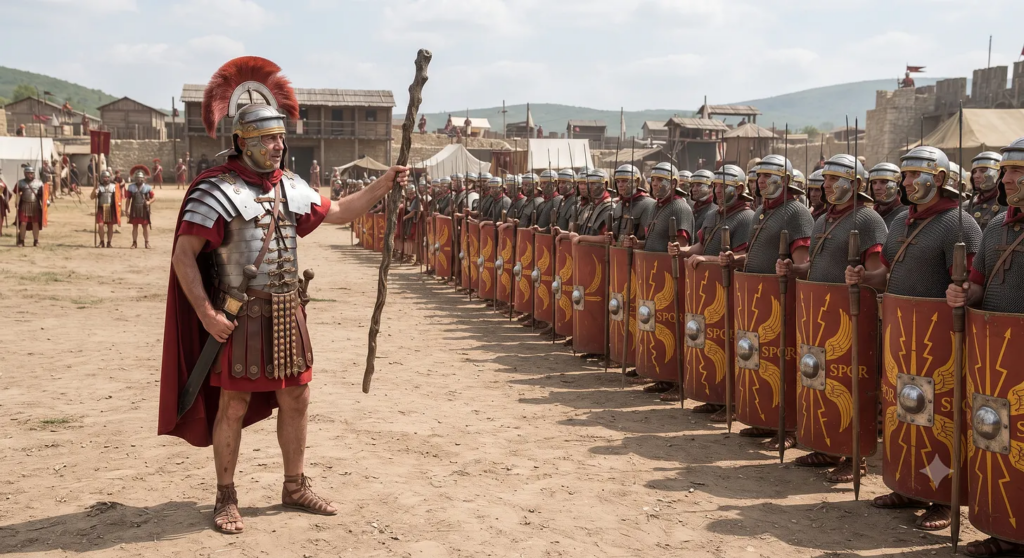
Ever wonder why so many public safety professionals feel like they are constantly fighting their own organization? The answer might be hidden in ancient history … specifically, in the Roman Army (circa 264 BCE – 146 BCE).
Even today, we see ancient structures causing the same problems they did thousands of years ago. To understand why, we have to look at how the Roman military worked.
The Roman Blueprint
The Roman Army was built on strict layers:
- Legions: Up to 6,000 men.
- Cohorts: 10 per Legion (the first had 800 men; the others had 480).
- Centuries: 6 per Cohort (originally 100 men, later reduced to 80).
- Groups: 10 groups of 8 men who lived and fought together.
A Centurion led each Centuria. As a badge of his rank, he carried a stout vinewood stick, a precursor to the batons used by military leaders up through the Korean War. If your modern CEO carries a “staff” like this, you should be concerned.
These sticks weren’t just for a show of authority. They were tools for punishment.
History tells of a Centurion named Lucilius, nicknamed in grim jest, “Cedo Alteram” (also found in some manuscripts as “Cedo Alterum”). It literally means something like “Give me another!” or “Bring me another!”He was so fond of cruelly breaking his vine staff (vitis) across his men’s backs that he kept an assistant nearby just to hand him a fresh one. Eventually, his men mutinied and killed him. Clearly, “old school” management wasn’t effective then, and it isn’t now.
From Ancient Rome to Modern Organizations
The words we use today reflect the story of this history:
- Line: Comes from the Latin linea (the way a “Century” was fielded).
- Staff: Comes from the Old English staef (the vinewood stick the Centurion carried).
Today, the “line” is our Patrol, Corrections, Firefighters, and Search & Rescue. These are the “legionnaires” dealing with offenders and closest to danger. Everyone else … Dispatch, HR, IT, Finance, Legal, Purchasing, Public Information, Risk Management, Training, Internal Auditing, and yes, Administration … is “staff.”
It sometimes comes as a shock to people in my leadership academies when I point out that Administration is NOT a line function; Administration is a staff support function. As an administrator, my job is to ensure that all systems are consistently removing obstacles so the line can safely and effectively do the jobs they are uniquely qualified for.
Two Problems:
- Many modern, I’m sure well-intentioned, “staff” members act like those ancient Centurions. Instead of understanding that their job is to support the line, that is, to remove obstacles that keep the line from properly functioning, they too often drive the line, requiring line employees to drop everything for their priorities, policies, procedures, their meetings, and their data.
- Whenever I see a proliferation of staff, especially at the expense of line positions, I can almost guarantee that the organization is in a crisis mode. Why? Because when you hire more staff people and give them jobs, the tendency is for them to find work, and the work they tend to find will be giving the line more work, which further distracts from focus on the objective.
True Honor is Support
A distracted line professional is a professional at risk. As an example, when staff members force new technology into patrol cars, control budgets without input, build a jail without involving Corrections professionals, or create endless red tape, they aren’t helping; they are interfering.
True honor for a staff member looks like this: “Sir, Ma’am, I am here to take everything off your list that doesn’t help you focus on your job and get it done for you.”
The Rules of Engagement
If you want a successful agency, you must ensure these are woven into the fabric of how you do business:
- Authority and Accountability: If someone has the authority to make a decision, they must be held accountable for the results. Failure to ensure that authority and accountability are coextensive creates a double-bind; double-binds are violations of employee safety in the workplace.
- The Objective First: The Line identifies the customer-driven objective. The Staff then aligns their work to support that objective. If a plan, policy, or procedure doesn’t help the line succeed, it should be eliminated.
- Stay in Your Lane: Elected officials (Mayors, City Council members, Board members, County Commissioners) should hire the CEO, approve the plan, and then get out of the way. When they try to “run” the daily operations, they are not leading; they are just creating a dangerous “double-bind” for the people in the field.
Leadership is not about being the boss; it is about serving the team. If your staff is making the line’s job harder, it is time to stop the “Roman-style” management and get back to the mission and a more effective order of operations.
My friends, students, and clients have found that one or more of the free assessments at my Strategic Diagnostic Hub can be helpful in getting things back on track.
If you have a problem you’d like to discuss in a no-obligation, confidential Zoom visit, you can self-schedule by clicking this button:

Author’s Note: The content provided in this article is designed exclusively for educational and informational purposes, reflecting opinions shaped by decades of leadership training and organizational consulting experience. It should never be interpreted as formal professional advice. By reading or engaging with this material, you acknowledge that no professional-client relationship is established and that these insights do not substitute for tailored guidance from a qualified professional familiar with your specific circumstances. Consequently, readers are strongly advised to seek independent counsel from licensed legal, financial, medical, or other appropriate advisors before implementing any strategies or making decisions based on these perspectives. Ultimately, you assume full personal responsibility for any actions you choose to take or omit as a result of reading this material, releasing the author and publisher from any liability for outcomes arising from your reliance on the text.
