


We have a massive problem with the word “leadership.”
For decades, we’ve wrapped the concept in an almost mystical shroud. We are told that true leaders possess a rare, innate “spark.” We look for the “Great Man” or “Great Woman” – the charismatic savior who can see a future no one else can see and move mountains through sheer force of personality.
We treat leadership like magic. Either you have it, or you don’t.
This is a dangerous and disempowering myth.
Here is a much-needed dose of reality: what we call “leadership” is simply mature adult behavior.
There is no magic, only maturity.
The Myth of “Leadership” vs. The Reality of “Adulting”
When we view leadership as magical, it becomes inaccessible. If you aren’t naturally charismatic or born with a commanding presence, the myth suggests you cannot be a leader.
But if we strip away the mystical descriptions, the “core behaviors” of leadership are just social and emotional skills that every well-adjusted adult should be practicing. The “magic” isn’t in some special power; it’s in the rare discipline required to remain an adult in high-pressure environments.
Let’s look at how the common leadership myths compare to basic adult reality:
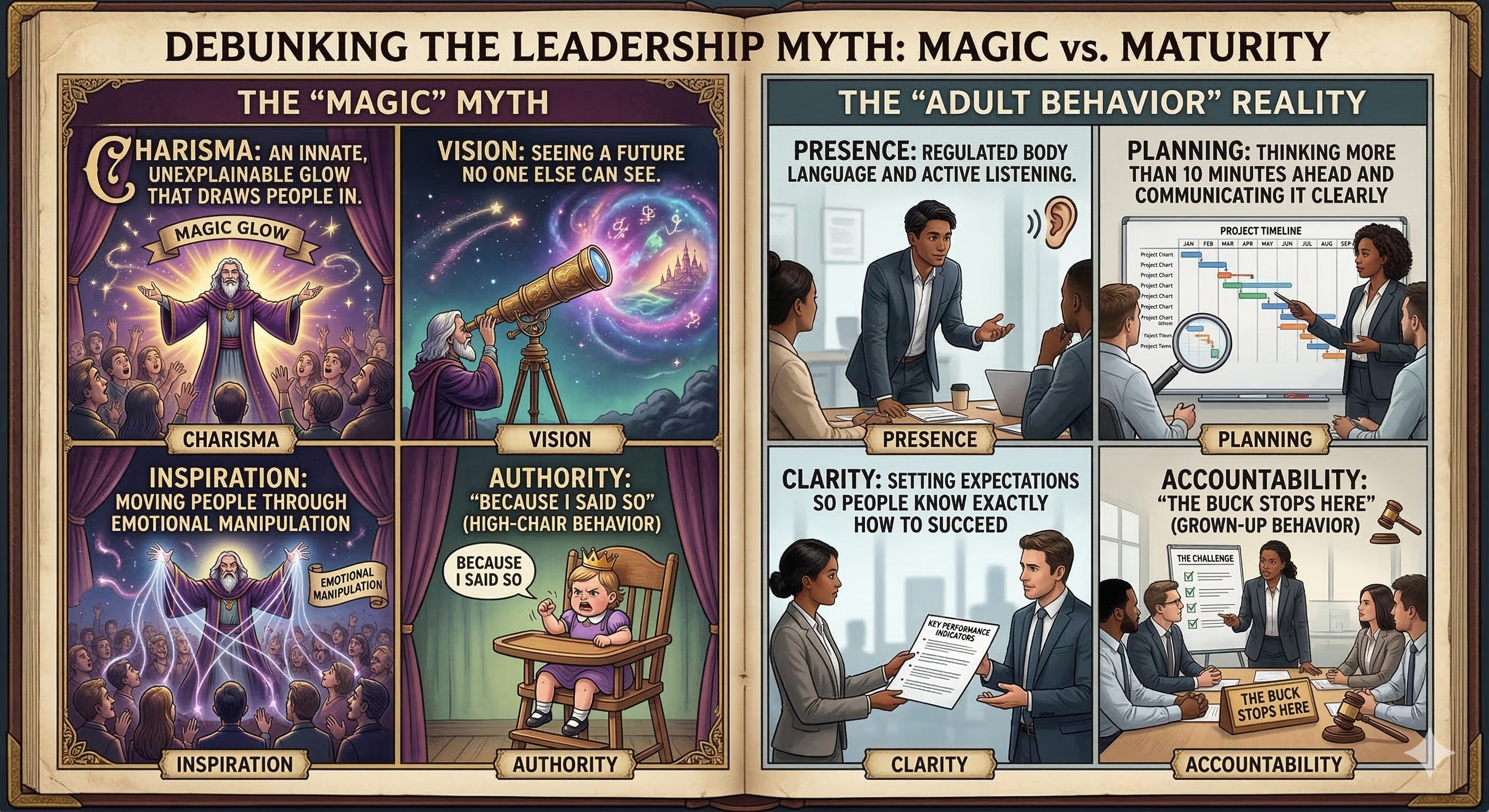
The Three Behavioral Piers of the Adult Leader
If leadership is just adult behavior, then developing leadership skills is just the process of increasing our social and emotional maturity. When leaders fail, they aren’t losing their “magic.” They are regressing to childish behaviors.
Here are the three behavioral piers where the adult leader separates themselves from the “corporate adolescent”:
1. Radical Emotional Regulation (No Tantrums)
A true leader doesn’t let a bad morning ruin the team’s afternoon.
At the heart of “presence” – that quality we so often attribute to leaders – is simply basic emotional self-control. It is the ability to feel a difficult impulse (anger, frustration, fear) and choose not to act on it. Children act on their impulses immediately. Adults are responsible for regulating them.
A “leader” is just an adult who, when stressed, doesn’t revert to kicking and screaming in public.
2. Delayed Gratification (Long-term Health Over Short-term Ego)
A true leader puts the long-term success of the mission, organization, or team above their own immediate need for validation or a quick “win.”
This is the behavioral scientist’s definition of maturity: choosing a larger, later reward over a smaller, sooner reward.
The mythical leader “chances the impossible.” The adult leader accepts the reality that meaningful progress often requires making small, boring choices today that don’t pay off for months. They resist the ego-boost of the instant fix and focus on building sustainable systems.
3. Absolute Accountability (Looking for Solutions, Not Someone to Blame)
When a child drops their ice cream cone, their immediate reflex is to point a finger. Someone didn’t hold it right. Someone bumped them. Someone made them look at something.
A true leader has outgrown the blame game. When a project fails, a team underperforms, or a mistake is made, the adult leader’s reflex is to ask: “What can I do to fix this?” and “What did I miss that contributed to this?”
We label this “taking extreme ownership” and treat it as a heroic leadership trait. It isn’t heroic. It’s just the basic requirement of being a responsible grown-up.
The Actionable Path Forward
The moment you accept that leadership is really just adult behavior, it stops being a mystery. You are no longer waiting for permission or hoping a “spark” develops.
Instead, leadership becomes a discipline:
- Stop looking for charisma and start practicing regulated, active listening.
- Stop hoping for vision and start developing the habit of structured planning.
- Stop waiting to feel authority and start accepting accountability.
Leadership is not about having a “magical sparkle.” It’s about not being the person who sucks all the air out of the room. It’s about being the person who has mastered their own ego well enough to hold space for others.
For more on the topic of being a Purposeful Adult, see my book: The Guidant Path: Organizational Series – The Master Collection.
If you have a problem you’d like to discuss in a confidential, no-obligation Zoom visit, you can self-schedule it by clicking on this button:

Author’s Note: The content provided in this article is designed exclusively for educational and informational purposes, reflecting opinions shaped by decades of leadership training and organizational consulting experience. It should never be interpreted as formal professional advice. By reading or engaging with this material, you acknowledge that no professional-client relationship is established and that these insights do not substitute for tailored guidance from a qualified professional familiar with your specific circumstances. Consequently, readers are strongly advised to seek independent counsel from licensed legal, financial, medical, or other appropriate advisors before implementing any strategies or making decisions based on these perspectives. Ultimately, you assume full personal responsibility for any actions you choose to take or omit as a result of reading this material, releasing the author and publisher from any liability for outcomes arising from your reliance on the text.
